Over the past five years, two bellwether indices have broken sharply apart.

This growing gap is not just a quirky chart pattern. It’s a macro signal worth dissecting.
- The Nasdaq Composite has surged to all-time highs, driven largely by a handful of mega-cap technology companies.
- The Dow Jones Transportation Average (DJT) — historically a leading economic indicator — has stalled, struggling to hold moderate gains.
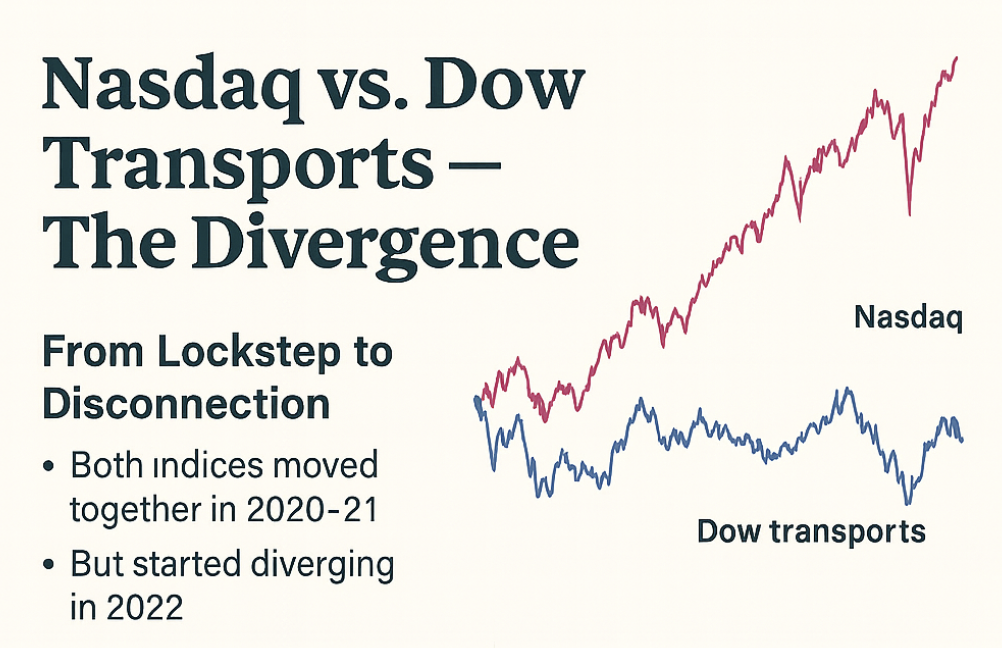
From Lockstep to Disconnection
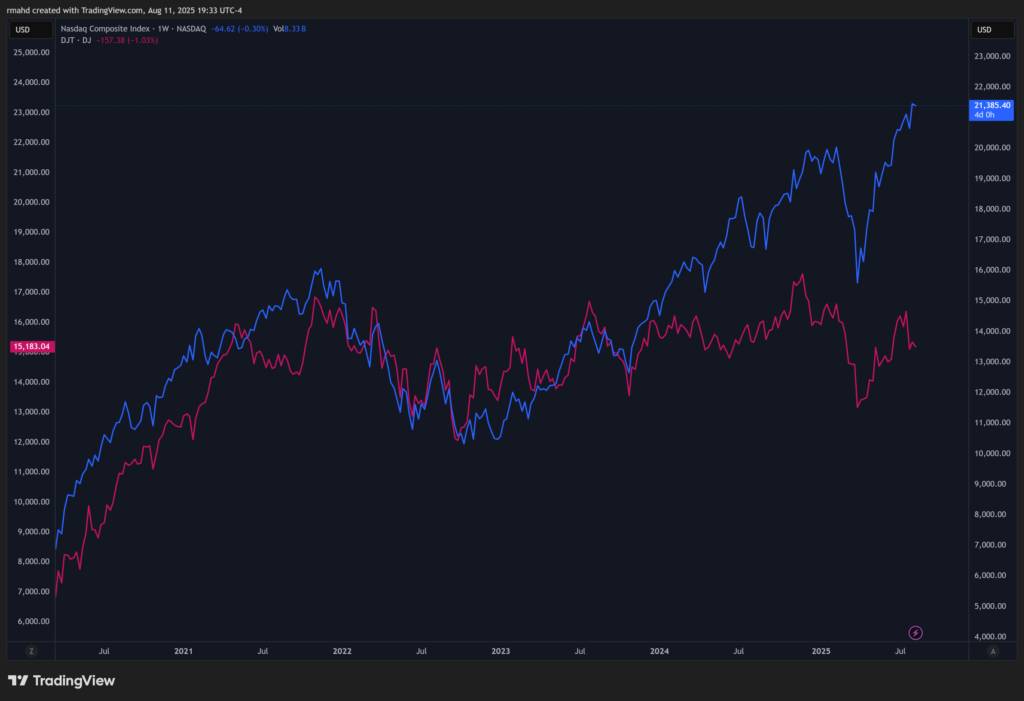
In the early phase of the post-pandemic recovery (2020–2021), tech stocks and transport companies rose together. E-commerce demand, supply-chain bottlenecks, and fiscal stimulus pushed both sectors higher.
But around mid-2022, the relationship began to fracture. While the Nasdaq regained momentum in 2023, powered by artificial intelligence hype and falling rate expectations, the DJT languished. By mid-2025, the Nasdaq was up over +160% from its 2020 base; transports sat closer to +40%.
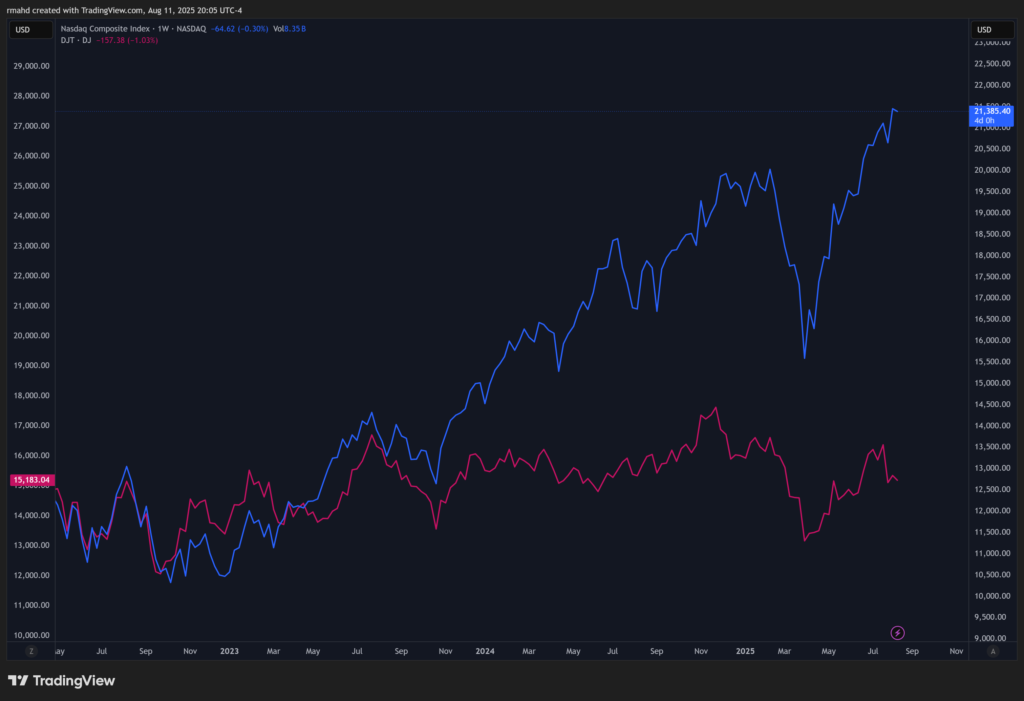
The Nasdaq is an index full of tech companies. The Dow Transports is a group of big shipping, airline, and trucking companies. If the economy is strong, these two usually go up together — because more business means more stuff gets moved. Here, they’re moving in different directions.
Why the Split?
1. Tech’s AI-Driven Rally

- Concentration effect: A small group of stocks — Nvidia, Microsoft, Apple, Meta, Alphabet, Amazon — are carrying the Nasdaq.
- Revenue without freight: Cloud computing, software, and AI services generate billions without moving physical goods.
- Rate sensitivity: Even a hint of monetary easing fuels growth stock valuations disproportionately.
Big tech companies are doing so well that they’re pulling the entire Nasdaq up. These companies make money from digital products, so their growth doesn’t require shipping anything in trucks or planes.
2. Freight Market Weakness
- Post-pandemic normalization: Goods demand has cooled as consumers pivot toward services.
- Overcapacity: Shipping and trucking capacity, built up during 2021’s supply crunch, is now weighing on rates.
- Margin pressure: Higher fuel, labor, and borrowing costs squeeze profits for capital-intensive carriers.
Transport companies made a lot of money during the pandemic shipping goods. Now demand has dropped, there are too many trucks and ships, and fuel and wages are more expensive. That’s hurting their profits.
3. Structural Economic Shift
The U.S. economy’s value creation is increasingly intangible. A trillion-dollar increase in market capitalization can now occur without boosting railcar loadings or container throughput. This decouples market performance from traditional transportation metrics.
Dow Theory and the Warning Sign

Under Dow Theory, a healthy bull market is confirmed when both the industrials and transports move in sync — the logic being that goods must be shipped for growth to be real. Today, transports are not confirming the Nasdaq’s rally. That doesn’t guarantee a downturn, but historically, such divergences have preceded market corrections or economic slowdowns.
Dow Theory is an old rule of thumb in investing: if the companies making things are doing well, the companies shipping those things should also be doing well. If one is up and the other is down, it might mean trouble ahead.
What It Means for Investors
- Macro caution: If transports are signaling weaker demand, GDP growth could underperform equity market expectations.
- Sector concentration risk: The Nasdaq’s rally is narrow; if leadership falters, there’s little breadth to support current valuations.
- Opportunities in cyclicals: A rebound in freight activity, should it occur, could offer upside in beaten-down transport names.
Investors should be careful — the market may be too dependent on a small group of tech companies. If transport stocks pick up, that could be a sign the economy is strengthening again.
Bottom Line:
The Nasdaq–Dow Transports divergence is a mirror of our economic moment: digital profits without physical movement. For now, investors are rewarding companies that live entirely in the cloud, while those moving goods on the ground remain stuck in traffic. Whether this represents a sustainable new paradigm or a late-cycle warning will be one of the most important macro questions of the next year.
Right now, the stock market is being powered by digital companies, while “real world” transport companies are falling behind. This could mean the economy is changing — or it could mean the market is getting ahead of itself.
Socials
X:https://x.com/breakingmetrics
Instagram:https://www.instagram.com/breakingmetrics
Substack:https://substack.com/@breakingmetrics
Stay ahead of the markets. Subscribe to Breaking Metrics for in-depth analysis on key levels, sentiment trends, and the forces shaping stocks, crypto, and the economy. Fraywire+ Members get insights like this before anyone else. Don’t miss a beat—subscribe today, for free.
The information provided in this newsletter is for educational and informational purposes only. It does not constitute financial, investment, legal, or tax advice. The content is not personalized to the needs, objectives, or financial situation of any individual reader. All investments carry a high level of risk, including the potential for loss of principal. The market analysis, predictions, and opinions expressed are based on the information available at the time of writing and should not be considered as a guarantee of future performance.
Please conduct your own research and due diligence before making any investment decisions. It’s advisable to consult with a qualified professional regarding your specific circumstances before taking any action based on the information presented here. The author and publisher of this article disclaim any liability for any direct or incidental loss incurred by applying any of the information in this article, including but not limited to, any loss or damages resulting from errors, omissions, or inaccuracies in the information provided. Remember that past performance is not indicative of future results.
Stay ahead of news and sentiment with www.glideslope.ai.